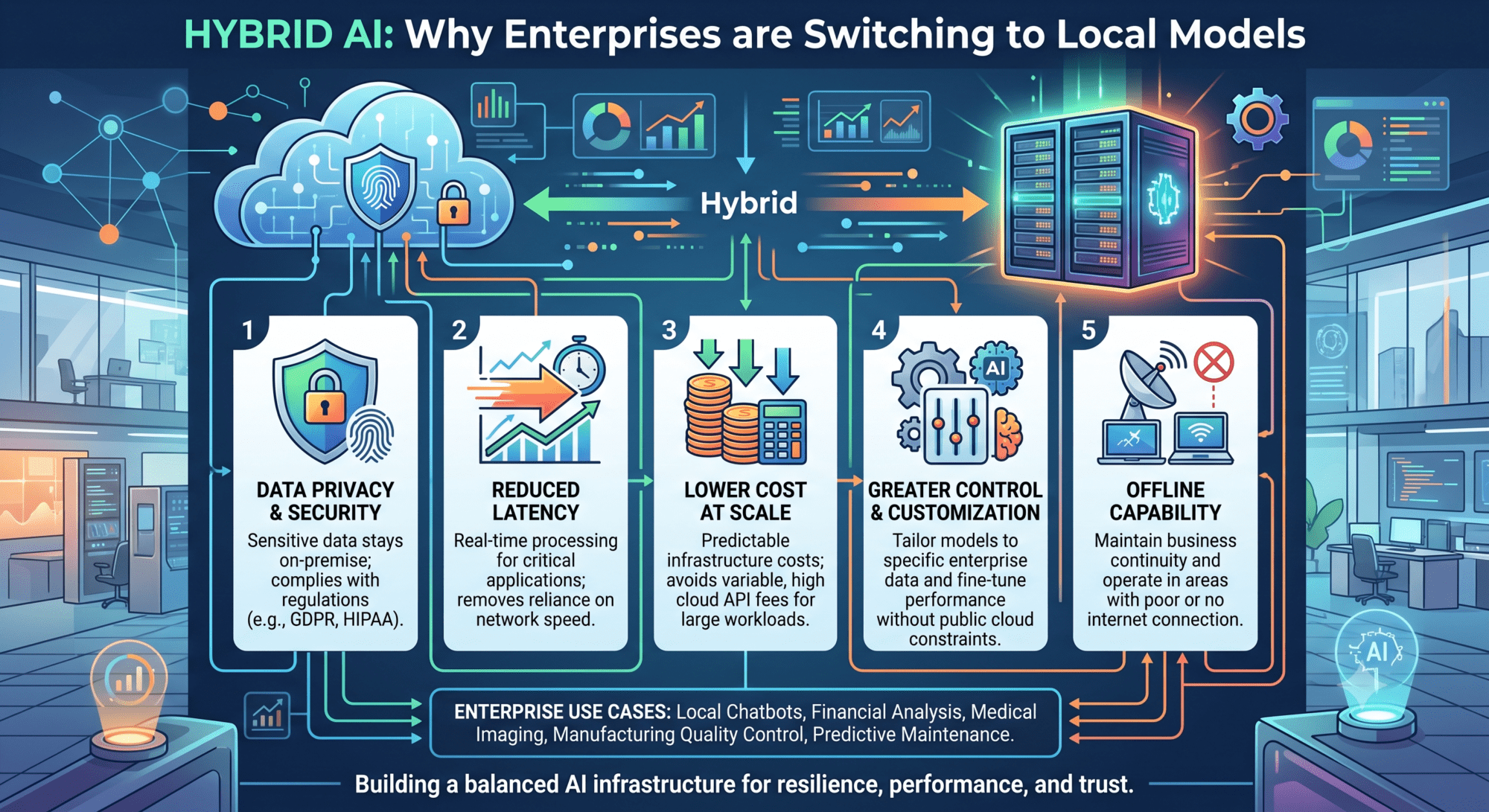
More than 85% of the Fortune 500 have adopted Ollama. For those unfamiliar with the tool, Ollama doesn’t provide a massive, proprietary model hosted in a distant data center; it allows developers and enterprises to download, run, and manage open models locally.
This is a quiet but violent pivot. For the last two years, the corporate narrative was simple: the bigger the model, the better the output. The goal was to plug into the most powerful cloud-based LLM available and hope the productivity gains offset the monthly API bill. But that era of “blind scaling” is ending.
The tension now lies between the promise of the cloud—infinite compute and “God-model” intelligence—and the reality of the edge, where latency, data residency, and cost create a hard ceiling. Enterprise leaders are realizing that while the cloud is great for training a model, it is often the wrong place to run it.
The sovereignty tax
The shift toward hybrid AI for enterprise isn’t just about speed; it is about survival in a fragmented regulatory world. In the fintech sector, 73% of organizations cite data privacy and security as their primary AI risk. This isn’t theoretical anxiety. It is a procurement mandate.
We are seeing the rise of “Sovereign AI,” where models are deployed on locally controlled infrastructure using locally governed data. The numbers are stark: 83% of companies now view data residency and local compute parameters as central to their strategic planning. Furthermore, 77% of firms now factor a tool’s country of origin into their vendor selection.
When a bank in Europe or a healthcare provider in the US looks at a cloud-based model, they don’t just see a tool; they see a liability. Moving the model to the data—rather than the data to the model—removes the risk. It transforms AI from a third-party service into a local utility.
The 94% bottleneck
If the motivation is security, the obstacle is the wire.
Most enterprise networks were built for a centralized world: users request data from a core server, and the server sends it back. AI traffic doesn’t work that way. It arrives in synchronized, high-volume bursts of machine-to-machine traffic. In a smart factory, a few milliseconds of latency between an edge inspection system and a model can mean a defective product rolls off the line before the system can trigger a halt.
This is why 94% of enterprise IT leaders now identify the network as the primary bottleneck to AI adoption. Legacy infrastructure is cracking under the pressure of “east-west” traffic—the data moving between clouds, models, and distributed compute environments.
As Perplexity CEO Aravind Srinivas points out, the model itself is no longer the product. The real value is now the “harness”—the orchestration system that pairs a model with the right tools and routes it to the right environment. The winner won’t be the company with the largest model, but the company with the most efficient routing.
The execution gap
Even with the right tech stack, enterprises are hitting a human wall. There is a widening “Reinvention Gap”—a 24-percentage-point difference between the change executives expect and the readiness employees actually feel.
This gap is often exacerbated by who is hired to implement the system. The default corporate instinct is to call a global consultancy for “scale” and “brand assurance.” While big firms are useful for multi-year change management across a dozen departments, they often lack the hands-on depth required for local deployment.
Boutique firms are winning the hybrid race because they ship models in regulated, data-heavy environments where the constraints are real, not theoretical. They don’t flood a project with hundreds of consultants; they focus on specific outcomes. For a founder or an engineer, the choice is clear: do you want a slide deck about transformation, or a working system in production?
The new architecture of intelligence
The future of the enterprise is not a single, monolithic AI, but a tiered system. Routine tasks—data entry, reconciliation, first-level support—will run on small, cheap, local models. Only the most complex, reasoning-heavy work will be routed to the expensive, power-hungry models in the cloud.
This hybrid approach solves the cost problem, the latency problem, and the privacy problem in one move.
The competitive edge is no longer about who has the best prompt or the most expensive subscription. It is about who has the network telemetry to handle the bursts and the local infrastructure to keep their data sovereign. The “AI race” has moved from the labs of San Francisco to the server rooms and factory floors of the enterprises themselves. Those who continue to rely solely on the cloud are not just paying a premium; they are building their future on someone else’s land.