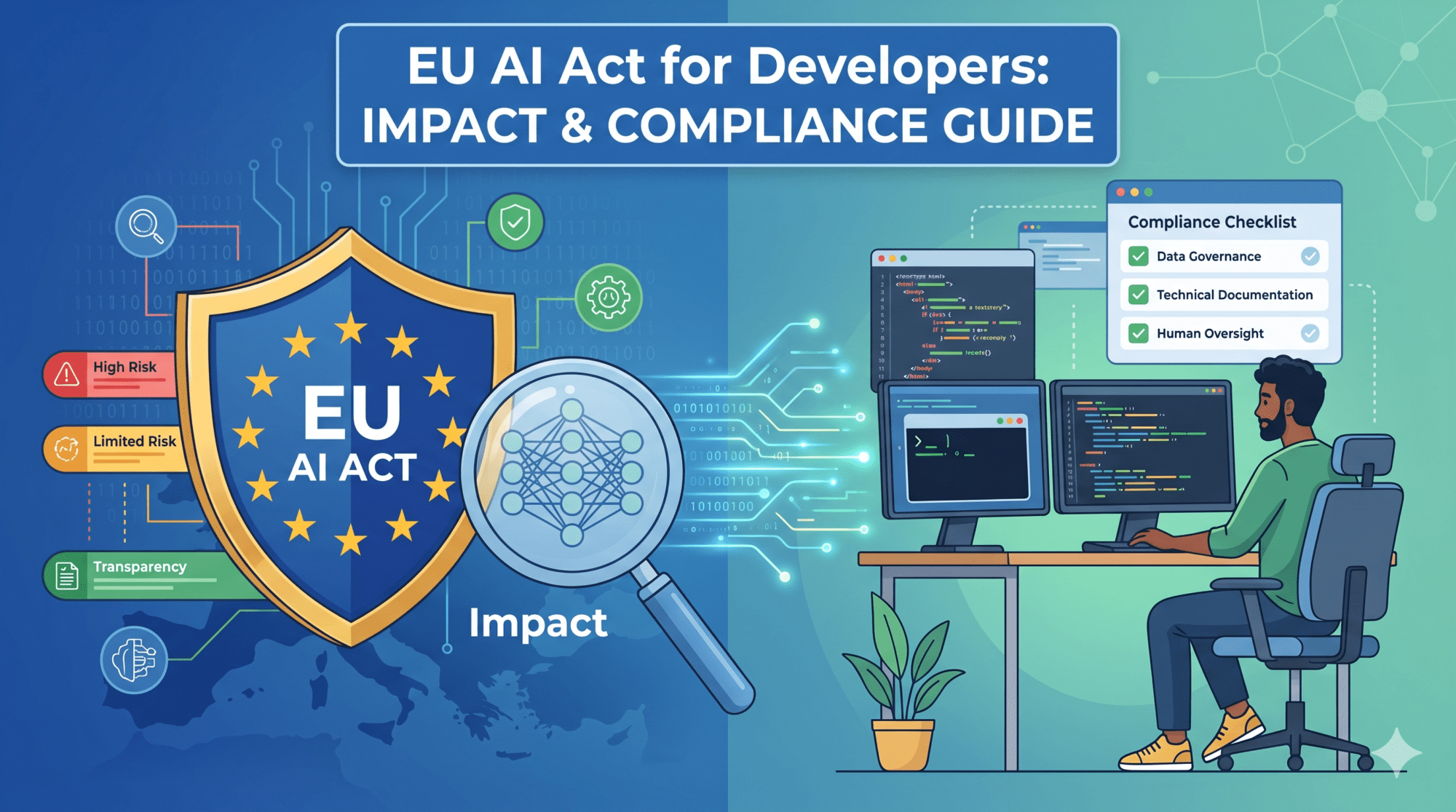
The European Union is rapidly reshaping the digital landscape, moving beyond simple guidelines to a rigorous regulatory framework. For those navigating the EU AI Act for developers, it is becoming clear that compliance is not just about the AI models themselves, but the entire ecosystem supporting them—from the cloud infrastructure they run on to the data used to train them.
The Expansion of Regulatory Oversight to the Cloud
One of the most significant shifts currently unfolding is the EU’s intent to bring cloud computing services under the umbrella of the Digital Markets Act (DMA). Regulators have identified cloud infrastructure as a “cornerstone” of the European economy and a fundamental prerequisite for AI.
Because over half of EU businesses rely on public cloud services, EU tech chief Henna Virkkunen has emphasized the need for these markets to remain fair, open, and competitive to secure Europe’s tech sovereignty. This means that the infrastructure provided by giants like Amazon and Microsoft is under intense scrutiny. While some providers argue that overlapping regulations—such as the Data Act—could deter innovation, the EU is prioritizing a competitive environment where AI tools and partnerships do not create unfair procurement advantages.
Moving Toward Digital Sovereignty
For developers, the concept of “digital sovereignty” is evolving. It is no longer just about data residency (where the data physically sits). In the era of agentic AI, sovereignty has become an operational necessity.
True digital sovereignty now spans several critical layers:
* Access and Governance: Who has privileged access to systems and how day-to-day operations are managed.
* Vendor Control: The ability to control third-party suppliers and port workloads without losing autonomy.
* Auditability: Creating defensible audit trails across the full technology stack.
To address this, there is a growing movement toward “compliance-by-design” and “sovereign-by-design” principles. This approach embeds sovereignty controls at the foundation of the architecture to reduce dependency on opaque access pathways. This is further supported by the EU’s €180 million sovereign cloud initiative, which aims to provide the necessary infrastructure layer for businesses to scale AI solutions while maintaining technical sovereignty.
Security, Resilience, and the Supply Chain
Compliance for the EU AI Act for developers also intersects with a broader “Tech Sovereignty Package.” This includes the updated Cybersecurity Act and the Cyber Resilience Act, which specifically target security risks within technology supply chains.
These measures are designed to limit dependencies on sensitive technology from critical infrastructure and prevent predatory dumping of tech into the European market. For developers, this means that the origin and security of the components used in their AI stack are now strategic considerations for business resilience and operational continuity.
The GDPR Tension: Data Protection vs. AI Training
Perhaps the most persistent challenge for developers in Europe is the tension between the General Data Protection Regulation (GDPR) and AI development. While 59% of companies view European data protection as an advantage for AI development, the practical application is more complex.
Recent findings indicate that 69% of respondents believe data protection rules make it difficult to train AI models with sufficient data. This has led to a paradoxical situation where AI models are frequently used within Europe, but are not developed there due to the bureaucratic burden and legal uncertainty.
Industry leaders are now calling for a more “risk-oriented approach” to the GDPR. The goal is to strengthen protection where real risks to individuals exist, while relieving companies of formal obligations that offer no additional protection, thereby allowing the training and operation of AI systems to flourish within the EU.
Final Thoughts for Developers
Navigating the EU AI Act for developers requires a holistic view of the tech stack. Compliance is no longer a checkbox at the end of production; it must be integrated into the infrastructure, the data procurement process, and the vendor selection strategy. By embracing sovereign-by-design principles and staying abreast of the evolving DMA and GDPR interpretations, developers can build resilient AI solutions that are truly compliant with European standards.